
ISO 14001:2026 and IED 2.0: From environmental compliance to strategic transformation
by Sebastian Katsch, Claire Bushell
View post
Reducing methane emissions from oil and gas (O&G) operations remains one of the most immediate and cost-effective opportunities to mitigate climate change. Yet despite growing regulatory pressure and voluntary commitments, such as OGMP 2.0, there is still a fundamental challenge:
To address this challenge, SLR introduced a new benchmarking approach that was recently presented at the CanCH4 Conference in Ottawa, ON, Canada, on May 22, 2026, [1] by Dr. Tecle Rufael.
The approach: source-level benchmarking at the basin and segment level shifts the focus from traditional but less actionable, company-wide inventory or intensity metrics to granular, measurement-based, actionable insights to drive reductions.
This study was sponsored by the Appalachian Methane Initiative (AMI), representing several upstream and midstream O&G operators in the Appalachian basin, and supported by our academic partners at the Energy Emissions Modeling and Data Lab (EEMDL) at The University of Texas at Austin.
Today, most O&G operators report companywide methane performance using intensity-based metrics—typically emissions normalized by gas production or energy output. While these metrics are useful for monitoring internal corporate targets, they fall short when used for benchmarking across operators. This is mainly because emissions can be heavily influenced by factors like reservoir characteristics, asset mix, facility size, and measurement methods. As a result, two operators with similar emission-control practices can appear to have different emission intensities depending on their asset portfolio or where they operate. This makes it difficult for companies and stakeholders to benchmark their relative performance and identify opportunities for mitigation.
We introduce a source-specific benchmarking framework built on direct, “as-measured” data from aerial methane surveys. Instead of relying on aggregated company-level metrics, this approach analyzes methane emissions at the equipment level, independent of operational data or root causes of emissions.
The framework is demonstrated using measurement data gathered from the AMI project, a multi-year campaign involving large-scale aerial surveys covering 82,000 km² across Pennsylvania, West Virginia, and Ohio. These campaigns collected detailed, source-resolved methane measurements across both AMI O&G participants and non-participating O&G operators. This empirical dataset enables a new level of insight into how emissions vary by equipment and facility types. The source-resolved metrics include ‘population emission factors’ expressed in kg/hr/surveyed unit, ‘detect emission factors’ expressed as kg/h/emitting unit, and ‘detect rate’ given as % of emitting units calculated for each facility type.
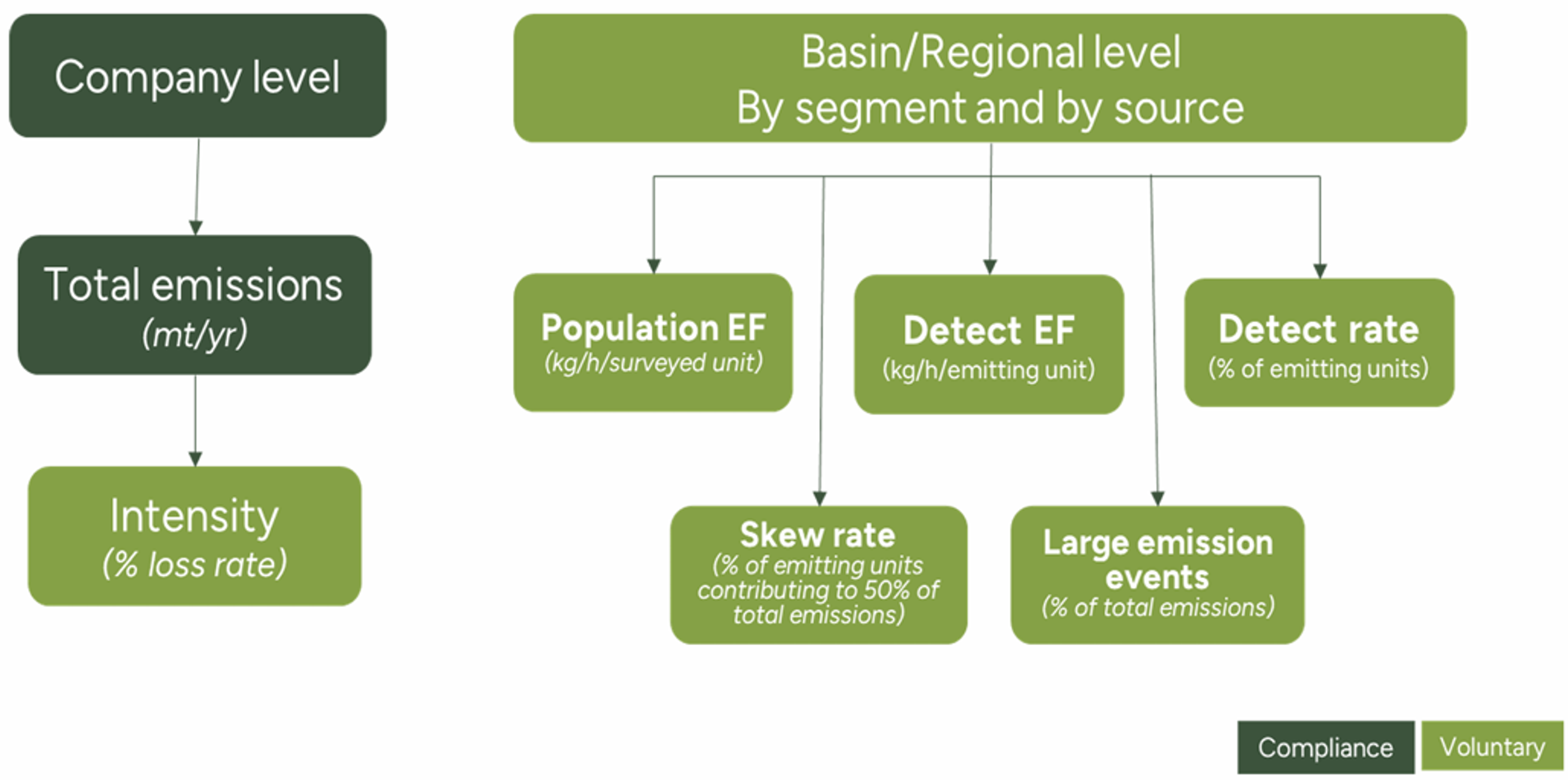
The goal of this framework is to enable meaningful and timely comparison with minimal level of effort. Instead of normalizing emissions by production to calculate a throughput-normalized intensity, the framework benchmarks average observed emissions rates (e.g., kg CH4/hr) at the equipment level.
For each operator, source-level benchmarking metrics were calculated for various facility types, such as:
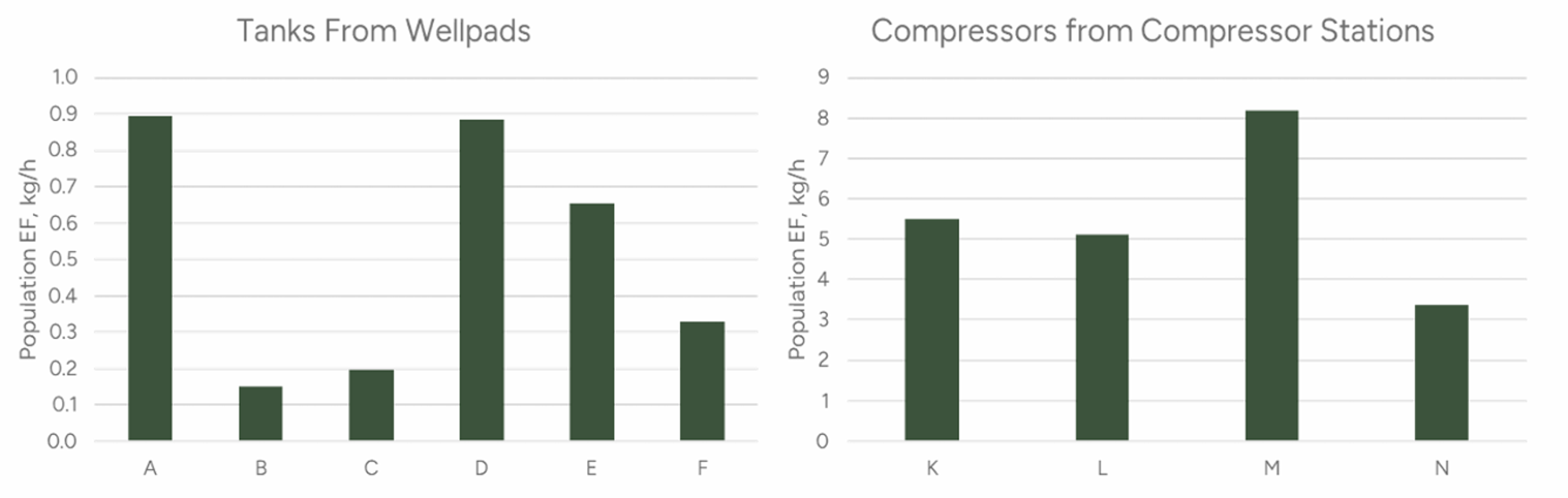
This benchmarking approach offers several advantages:
One of the most compelling aspects of this approach is its direct link to mitigation strategies. Even within a single basin, traditional metrics like methane intensity often mask true performance differences due to structural variation across operators, and obscure the main drivers of methane emissions. While intensity-based metrics may indicate that an operator's overall methane intensity is high, they provide limited insight into the sources of those emissions. In contrast, source-level benchmarking highlights the specific sources driving performance differences, enabling a more targeted and actionable assessment of mitigation opportunities. For example, it can help answer questions such as:
This shifts the focus from historical absolute or throughput-normalized emissions to the quasi-real-time performance of individual equipment. This enables targeted interventions such as:
This approach removes the complexities of measurement-informed annual emissions accounting and instead takes a source-level performance-based approach to quickly identify potential abatement opportunities. By quickly identifying high-emitting equipment from an operator’s own facilities, operators have a higher chance of diagnosing issues in the field and reducing total emissions following each aerial survey. This framework aligns methane benchmarking with actionable insights, transforming emissions data into a practical decision-making tool.
While this approach offers more granular benchmarking using timely, rapidly processed data, it does not diminish the value of conducting causal investigations to better understand emissions drivers and identify mitigation opportunities. Such analyses can provide important insights for developing targeted mitigation strategies, but they typically require considerably more time and effort.
While this approach offers several advantages, as discussed in this article, it is not intended to replace existing inventories or reporting frameworks. Instead, it is designed to complement them by providing additional insights that traditional metrics may overlook, with an emphasis on the timely delivery of decision-useful data.
However, this direct comparison also introduces certain challenges. Access to measurement technologies that can produce source-level data is a key limitation, since technology availability or cost may be a hindrance for some operators or regions around the world. In addition, for comparisons to be fair and meaningful, participating operators in a basin or region would need to use the same (or very similar) source-resolved technology. Similarly, surveys should be conducted within comparable timeframes, ideally during the same period of the year, to avoid potential seasonal variabilities. This framework also assumes ergodic behavior of emission sources, which relies on large sample populations or frequent surveys, which may not be feasible in all circumstances.
Therefore, while this approach can deliver valuable insights, it is important to recognize and address these limitations. When these challenges are properly managed, the resulting insights can provide highly specific emissions information, enabling faster and more effective mitigation actions.
SLR has extensive experience in GHG emissions management, supporting operators with measurement-based inventories and benchmarking to improve methane performance. Through its work on large-scale field measurements and initiatives, SLR has firsthand experience deploying multiple technology providers and developing consistent methodologies to enable meaningful comparisons among peers and to identify actionable mitigation opportunities.
We support the process end-to-end, from strategy and protocol development, selecting measurement technologies, data collection and analysis, inventory preparation and reporting, and identifying mitigation opportunities.
Contact us
by Sebastian Katsch, Claire Bushell

by Simon Hodgson, Daniel Witte, Blake Zheng

by Ashley Gibson